
Best Carp Rods for UK Waters: How to Choose the Right One
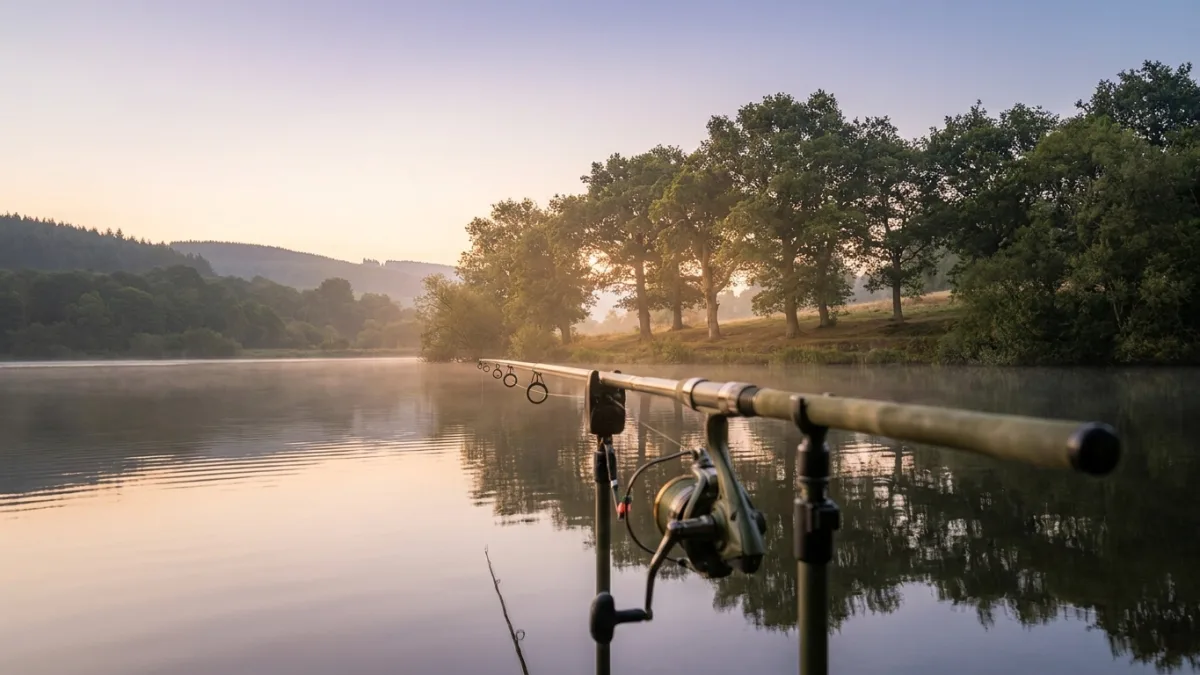
Pick the wrong rod and every session suffers. Here's how to get it right.
Key Facts
A 2.25 lb TC, 12ft rod covers most UK club lakes and day ticket venues. Match test curve to your average fish, not your biggest hoped-for catch.What You'll Gain
Get the rod-to-lead pairing right and you'll cast further, present better, and play fish more confidently, without spending more than you need to.Watch Out For
Buying a heavy TC distance rod for a small lake is the most common mistake. It kills sensitivity, wrecks presentation, and makes every session harder than it needs to be.
Choosing a carp rod shouldn't feel like a gamble. Test curve, length, and action all need to match your actual fishing situations, not the ones you see on YouTube. I've broken it all down so you walk away knowing exactly what to buy and why.
What Makes a Carp Rod Right for UK Waters
Choosing the best carp rod for UK fishing comes down to three things: test curve, length, and build quality matched to your actual fishing situations.
A rod that works brilliantly on a small club lake will feel completely wrong on a big open reservoir, and vice versa.
UK carp fishing covers everything from snag-heavy estate lakes to wide-open gravel pits. There’s no single “best” rod. What there is, though, is a best rod for you based on where you fish, how far you cast, and what size fish you’re targeting.
This guide breaks it all down so you can make a confident, informed decision.
Before you even pick up a rod, make sure you’re legal. According to GOV.UK, you must have a rod fishing licence for England and Wales if you’re fishing for freshwater fish with a rod and line, including on private club waters and day ticket lakes. Fishing without one can result in a fine of up to £2,500. Junior licences (ages 13 to 16) are free, and children under 13 need no licence at all.
Understanding Test Curve: The Most Important Number on Any Carp Rod
If you only understand one thing about carp rods, make it test curve (TC). It’s the single biggest factor in how a rod performs.
What Test Curve Actually Means
Test curve is the weight required to pull the rod tip to a 90-degree angle from the butt. It’s measured in pounds (lb).
What Is Test Curve?
Test curve (TC) is the weight in pounds needed to pull the rod tip to a 90-degree angle from the butt. It determines casting power, fish-playing ability, and lead weight compatibility.
Core carp rod specification, UK standard- 1.75 lb TCLight, short-range work, small waters
- 2.25 lb TCAll-round rod, the most popular choice in the UK
- 2.75 lb TCMedium-long range, larger waters
- 3 lb TCLong-range casting, big open venues
- 3.5 lb TC and aboveSpecialist distance casting, heavy leads
The 2.25 lb TC is the workhorse of UK carp fishing. It handles most situations on club lakes, day ticket venues, and small to medium-sized pits without compromise.
Matching Test Curve to Your Target Fish
Test curve also influences how much pressure you can apply to a fish. Here’s a rough guide:
| Fish Size | Recommended TC | Typical Scenario |
|---|---|---|
| Under 10 lb | 1.5 to 1.75 lb | Small fisheries, margin work |
| 10 to 20 lb | 2 to 2.5 lb | Club lakes, most UK venues |
| 20 to 30 lb | 2.5 to 3 lb | Day ticket pits, big commons |
| 30 lb+ | 3 to 3.5 lb | Specimen hunting, large gravel pits |
| Distance specialist | 3.5 lb+ | 100+ yard casting situations |
The Common Mistake Anglers Make with TC
Many anglers go too heavy too soon.
A 3.5 lb rod feels impressive in the shop. But it’s brutal to use at 40 yards on a small lake. You lose sensitivity, your presentation suffers, and playing fish feels like winching rather than fishing.
Start with a 2.25 lb or 2.5 lb TC. You’ll be surprised how capable they are.
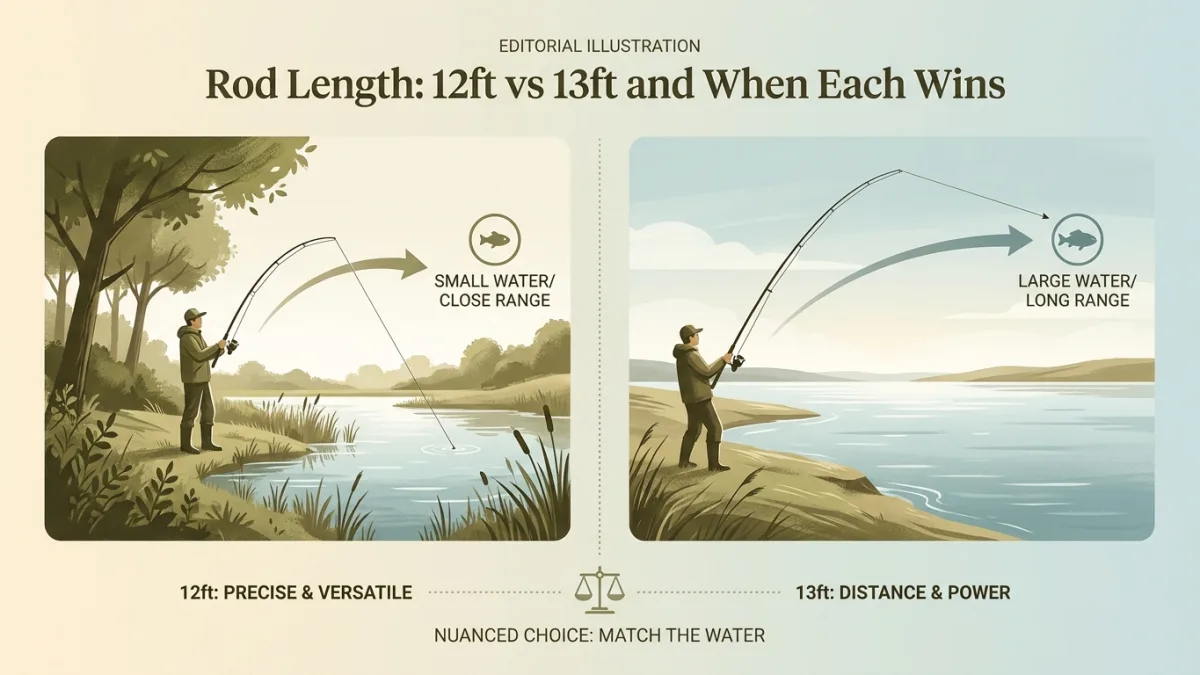
Rod Length: 12ft vs 13ft and When Each Wins
This is one of the most-asked questions in UK carp fishing. The answer is more nuanced than most people suggest.
The Case for 12ft Rods
A 12ft rod is the traditional UK standard for a reason:
- Easier in tight swims
- Lighter on long sessions
- Best up to 80 yards
- More affordable entry level
- Extra leverage for distance
- Reduces line drag on retrieve
- Ideal for open venues
- Reaches fish at 100+ yards
- Easier to handle in tight swims with overhanging trees
- Lighter and less fatiguing on long sessions
- Better for close to mid-range fishing (up to around 80 yards)
- More responsive when playing fish at close quarters
- Generally more affordable at the entry level
If you’re fishing small to medium-sized club lakes, rivers, or venues with restricted bankside space, a 12ft rod is almost always the smarter choice.
The Case for 13ft Rods
13ft rods have grown significantly in popularity, and for good reason:
- Extra leverage translates to noticeably more distance
- The additional length helps keep the line higher on the retrieve, reducing drag
- Better for open, snag-free venues where distance matters
- Increasingly popular on large UK gravel pits and reservoirs
The extra foot makes a real difference when you’re trying to reach showing fish at 100+ yards. On the right venue, it’s not a gimmick, it’s a genuine advantage.
Which Length Should You Choose?
Be honest about where you actually fish most of the time:
- Mostly small/medium lakes → 12ft
- Big open pits or reservoirs → 13ft
- Mixed bag of venues → 12ft 2.5 lb TC covers the most ground
Don’t buy a 13ft rod to fish a 3-acre club lake. The extra length creates more problems than it solves in confined spaces.
Rod Action: Fast, Through, or Compound?
Test curve tells you the power. Action tells you how the rod bends and where.
This affects casting, bite indication, and fish playing. It’s worth understanding properly.
Fast Taper (Tip Action)
The rod bends predominantly in the top third. This gives:
- Crisp, powerful castinggreat for long-range work
- Excellent for bolt rig fishing where you want a stiff blank to set the hook
- Less forgiving when playing fish at close range
- Better with heavier leads (2 to 4 oz)
Most distance-oriented rods lean toward a faster taper.
Through Action (Full Compound)
The rod bends more evenly from butt to tip. This gives:
- Superior fish playingthe rod cushions lunges and reduces hook pulls
- More satisfying to use on lighter lines
- Better for surface fishing or floater rigs
- Less raw distance but more control
Compound Taper
Most modern carp rods sit somewhere in between, a compound taper that loads progressively but kicks in the tip section during the cast.
This is the sweet spot for all-round UK fishing. Brands like Daiwa, Nash, Sonik, and Shimano have refined compound tapers to the point where you get genuine distance and good fish-playing characteristics from the same rod.
Key Build Features to Look for When Buying
Beyond the headline specs, the construction details separate a good rod from a great one.
Blank Material and Quality
The vast majority of quality carp rods use carbon fibre blanksbut not all carbon is equal.
According to Rod Forge, carbon fibre in rod blanks is defined by its tensile modulusessentially how stiff the fibre is. Higher modulus carbon is stiffer and lighter but less forgiving. Lower modulus carbon is heavier but more durable. Most fishing rods are built using fibres in the 30 to 40 million modulus range, with selective use of higher modulus fibres depending on application.
For most UK anglers, a mid-modulus carbon blank hits the sweet spot, light enough to cast comfortably all day, tough enough to handle the occasional knock.
Look for:
- Shrink wrap or duplon handlespersonal preference, but duplon tends to be more durable
- Fuji or equivalent quality ringscheap rings groove quickly and damage line
- Consistent finish on the blankany warping or uneven sections is a red flag
Ringing Configuration
The number and placement of rings affects casting distance and line management.
Low-rider rings sit close to the blank and reduce friction during the cast, improving distance. Most modern carp rods use a low-rider configuration as standard.
When it comes to ring insert material, Fuji Kogyothe industry benchmark for rod guides, describe their SiC (Silicon Carbide) rings as offering “super heat dissipation, super hardness, super low friction.” On quality carp rods, SiC or Alconite inserts are the standard to look for. Cheap aluminium oxide rings groove under braid and shorten line life noticeably.
Butt Cap and Reel Seat
A quality Fuji reel seat keeps your reel locked firmly in position, no movement, no wobble. On budget rods, the reel seat is often the first thing to show wear. It’s worth checking before you buy.
The butt cap should be solid and well-fitted. A loose butt cap lets water in and weakens the blank over time.
Best Carp Rods for UK Anglers: Practical Recommendations by Situation
Rather than a generic “top 10” list, here’s a breakdown by fishing scenario, because context matters far more than brand loyalty.
Budget Picks (Under £80 per rod)
You don’t need to spend a fortune to get a capable carp rod. Several brands offer solid blanks at entry-level prices:
- Sonik SK-TEKConsistently well-reviewed for build quality at the price point. Available in 2.75 lb and 3 lb TC.
- Daiwa Black WidowA long-standing UK favourite. Reliable, well-built, and widely available.
- Nash ScopeExcellent value, especially in the 2.5 lb TC for all-round use.
At this budget, prioritise build quality over exotic features. A simple, well-built rod will outperform a gimmick-heavy cheap one every time.
Mid-Range Picks (£80 to £150 per rod)
This is where the quality really starts to show. Blanks become noticeably lighter and more responsive:
- Shimano TX-7ASuperb all-rounder, available in multiple TC options. Popular on UK day ticket venues.
- Daiwa Longbow X45Excellent for distance work, well-regarded on larger UK pits.
- Fox Horizon X3Trusted by a huge number of UK carpers, consistently performs across a range of venues.
High-End Picks (£150+ per rod)
At this level, you’re paying for marginal gains, lighter blanks, better components, finer tolerances. Worth it if you fish seriously and regularly:
- Nash Scope BlackRefined version of the Scope range, noticeably lighter in hand.
- Korda KamoBuilt for serious distance work, well-suited to large UK gravel pits.
- ESP Terry Hearn Mk2A cult rod among UK specimen hunters, exceptional through-action.
You don’t need to spend £200 per rod to catch carp. But if you’re fishing 3 to 4 times a week on demanding venues, the investment in quality makes sense.
Rod Selection Summary
| Scenario | Recommended TC | Recommended Length | Budget Range |
|---|---|---|---|
| Small club lake, close range | 2 to 2.25 lb | 12ft | £50 to £100 |
| All-round UK fishing | 2.25 to 2.5 lb | 12ft | £80 to £150 |
| Large gravel pit, mid-range | 2.75 to 3 lb | 12 to 13ft | £100 to £180 |
| Distance specialist | 3 to 3.5 lb | 13ft | £120 to £250+ |
| River or snaggy venue | 2.5 to 3 lb | 12ft | £80 to £150 |
Matching Your Rod to the Rest of Your Setup
A great rod paired with the wrong reel or line is a wasted investment. Here’s how to make sure everything works together.
Reel Pairing
For a 2.25 to 2.5 lb TC rod, a reel in the 5000 to 6000 size bracket works well.
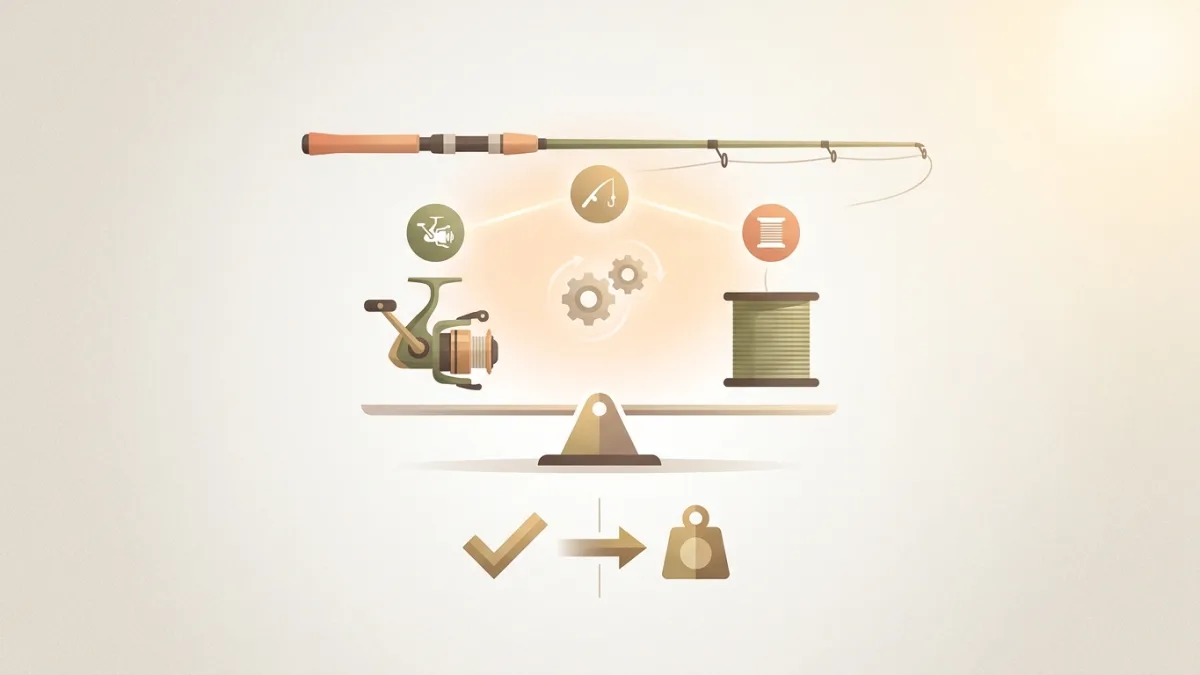
Rod Setup Pairing Rules
5 points- 1 Match a 2.25–2.5lb TC rod with a 5000–6000 size reel
- 2 Use 10–15lb mono or 20–30lb braid on 2–2.5lb TC rods
- 3 Use 15–20lb mono or 30–40lb braid on 3lb+ TC rods
- 4 Lead weight in ounces should roughly match TC in pounds
- 5 Buy rods as a matched set of three for consistent casting
Larger reels (8000+) suit heavier TC rods used for distance work, where you need more line capacity and a bigger spool for longer casts. Line lay on the reel matters too, a poorly spooled reel creates coils that rob you of casting distance regardless of how good the rod is.
Line Choice
The rod’s TC influences your line choice:
- 2 to 2.5 lb TC rodsGenerally paired with 10 to 15 lb mono or 20 to 30 lb braid
- 3 lb TC and aboveCan handle 15 to 20 lb mono, 30 to 40 lb braid for distance work
Using too light a line on a powerful rod risks breakage. Too heavy a line on a light rod kills casting performance.
Lead Weight
This is often overlooked.
Casting a 3 oz lead on a 1.75 lb TC rod is asking for trouble, you’ll overload the tip. Equally, a 3.5 lb TC rod feels dead and unresponsive with a 1 oz lead.
A rough guide: lead weight in ounces should roughly match the TC in pounds. A 2.5 lb TC rod is comfortable casting 2 to 3 oz leads. A 3 lb TC rod works well with 3 to 4 oz.
Get the rod-to-lead pairing right before you worry about anything else. It’s the foundation of a functional setup.
Common Mistakes UK Anglers Make When Buying Carp Rods
Avoiding these errors will save you money and frustration.
Buying for the Venue You Wish You Fished
It’s easy to get inspired by big-pit carping videos and buy a 13ft 3.5 lb TC distance rod, then spend the entire season fishing a 5-acre lake at 40 yards. Be realistic about where you actually fish.
Rod Licence Required by Law
Annual 2-rod licence costs £36.80. Buy yours at gov.uk/fishing-licences before your next session.
Prioritising Brand Over Spec
Brand loyalty is fine. But a well-specced rod from a lesser-known brand will outperform a poorly-specced rod from a famous one. Focus on TC, action, and build quality first. Brand second.
Buying Mismatched Sets
A lot of anglers buy three rods of different ages, brands, and TC ratings. This creates inconsistent casting and makes bite indication harder to read.
If you can, buy your rods as a matched set of threesame TC, same length, same action.
Ignoring the Warranty and After-Sales
UK fishing brands vary significantly in how they handle warranty claims.
Shimano’s UK warranty policy covers repair or replacement of defective rods, and if a defect is confirmed, the repair or replacement is carried out without charge. Established brands with strong UK distribution networks are generally far easier to deal with if something goes wrong.
Check the warranty terms before you buy, especially on rods over £100.
Frequently Asked Questions
Several top brands consistently stand out for UK carp fishing. Names like Daiwa, Shimano, Fox, Korda, Wychwood, and Sonik all deliver genuine performance across different budgets. Korda’s Kaizen range has earned strong praise for its casting ability and fish-playing action, built around a fast-tapered blank with high compression strength for impressive distance and accuracy. Daiwa’s flagship blanks, including the Infinity and Longbow X45 ranges, are widely regarded as some of the finest engineering available. The good news is that the gap between budget and premium rods has narrowed significantly, so you don’t need to spend a fortune to fish effectively.
It depends entirely on the type of water you’re fishing. A 12ft rod is the most popular choice because it’s versatile, capable of reaching decent distances while remaining manageable on smaller venues, and widely considered the “Goldilocks zone” of carp tackle for the majority of UK fishing situations. A 13ft rod gives you extra leverage and can add meaningful yards to your cast, making it better suited to big pits and long-range work. That said, if you can’t fully load a 13-footer with your technique, that extra foot won’t help you. Some anglers now opt for a 12ft 6in compromise, which bridges the gap nicely, adding enough extra distance to be noticeable without feeling cumbersome or too long for most swims.
A 3lb to 3.25lb test curve is a well-rounded starting point for targeting carp on most UK waters. It gives you enough backbone to control a powerful fish and cast leads or PVA bags comfortably, without being so stiff that it loses its fish-playing action. If you’re fishing snaggy or weedy venues, stepping up to a 3.5lb test curve gives you the extra authority to bully fish away from danger, and is also a popular choice for longer-range work. Reserve 3.75lb+ rods for extreme-distance or specialist big-pit sessions where you need maximum casting power and control near heavy snags.
Yes, rod action is just as important as test curve, and the two work together. A fast-taper action loads mainly in the tip under lighter loads, then bends through the full blank under heavier loading, delivering maximum tip speed for distance casting. A through-action rod bends progressively from tip to butt, absorbing the lunges of a big fish and reducing the risk of hook pulls, though it sacrifices some outright casting distance. For most UK carp fishing, a medium or progressive action hits the sweet spot: enough power to cast confidently with PVA bags and leads, with enough flex to play fish safely without requiring specialist casting technique. Matching the action to your fishing style matters more than chasing the highest test curve on the shelf.
Yes, if you’re fishing in England or Wales, a rod licence is a legal requirement. According to GOV.UK, anyone aged 13 or over fishing for freshwater fish (including carp) must hold a valid Environment Agency rod licence. A standard annual 2-rod trout and coarse licence costs £36.80, while a 3-rod licence (popular with carp anglers running three rods) costs £55.30 per year. Junior licences for anglers aged 13 to 16 are free. Fishing without a licence can result in a fine of up to £2,500. You can buy your licence quickly and easily at gov.uk/fishing-licences.